How to navigate the places where family and business overlap

When to Hire a Family Business Consultant
This search rarely happens on a good day. It happens after a meeting where the real topic got tabled again, or on the drive home from ten hours beside people you love, realizing nothing that mattered got said.
If that's where you are, this page is for you. It covers the signs it's time, what a family business consultant does, what the work costs, and how to choose someone you can trust with something this personal.

Six signs it's time
You don't need all six. In my experience, to or three that have lasted more than a year are enough.
01
The same conversation keeps getting postponed. It's on the agenda, then it isn't. Someone clears their throat, eyes drop, and the table agrees to circle back next quarter. You've circled back three quarters running. The conversation you're avoiding is usually the one that would move the business forward.
02
Every decision routes back to you. Things get decided in the meeting, and at 11pm you're lying awake re-deciding them. Handing something off means checking it twice. That kind of carrying works until it doesn't, and it's usually the leader who breaks before the business does.
03
You're together all day and far apart. Polite. Efficient. Strangely distant. You've become partners who manage each other, and the family part of the family business has thinned out. This one hurts the most because it's the reason you built it together in the first place.
04
Growth got heavier instead of easier. Same fires, re-lit weekly. A handoff fails because the process lived in someone's head. Revenue is up and so is the friction. That's rarely a people failure. It's a sign the business has outgrown the way it's being run.
05
You can't tell which hat you're wearing. Parent, sibling, CEO, sometimes in a single sentence. You rewrite one message three times so it lands as leadership instead of betrayal. Role confusion is exhausting for you and confusing for the people reading you.
06
Succession is "almost ready." It has been for years. The folder exists. It gets opened, looked at, and closed before the meeting starts. Underneath the delay there are usually two unspoken questions: the founder's "if I hand it over, who am I?" and the next generation's "do they trust me with what they built?" A plan can't move until those get said out loud.
What a family business consultant does
Family businesses break at an intersection: where the relationships meet the operations. Most help is built for one side or the other. An operational consultant will redesign your org chart without touching the tension in the room. A therapist will work the relationships without ever opening the P&L. A family business consultant works where they meet, because in your business they can't be separated.
In practice, the work looks like this:
01
Facilitating the conversations you've been avoiding. A neutral third party changes the physics of the room. Things get said, received, and turned into decisions instead of wounds. In my practice this runs on the OUR Method: observe what's happening beneath the words, understand the emotional and the operational layers at once, then respond in a way that creates clarity instead of fallout.
02
Clarifying roles and decision rights. Who decides what, who owns what, and what happens when owners disagree. Written down, agreed to, and referred to when it counts.
03
Building the systems that carry the weight. Moving the business from person-driven to process-driven so growth stops depending on any one set of shoulders, including yours.
04
Preparing the transition. Succession as a series of honest conversations and staged handoffs, started well before a date forces it.
The rhythm is steady rather than dramatic: regular working sessions with the leaders involved, real agendas, and agreements that get kept between meetings. Micro-shifts, placed where they matter, tend to produce results out of proportion to their size.
What this work is not
Consultant, coach or therapist?
A quick way to sort it. A coach develops one leader: your clarity, your decisions, your growth. A family therapist heals the family system, with the business as backdrop. An operational consultant fixes mechanics: processes, structure, margins. A family business consultant works the intersection, and brings the others in when they're the right tool. If your challenge lives in one clean lane, hire for that lane. If it keeps jumping lanes, from the boardroom to the dinner table and back, you're in family business consultant territory.
What it costs
Fees follow scope: how many leaders are involved, how tangled the situation has become, and whether the work includes operations, facilitation, or both. Any consultant worth hiring will scope it with you before quoting it.
The more useful math is the cost of waiting. One key manager who leaves over unresolved tension. One expansion that stalls because two owners can't align. One succession postponed until a health event decides it for you. Measured against those, the engagement is rarely the expensive option.
That's also why the first conversation with me is complimentary. You should be able to find out what the work would look like, and what it would cost, before spending anything.

How to choose one
Whoever you talk to, me included, ask these five questions:
If the answers create more safety than pressure, you've probably found your person.
Where I come in
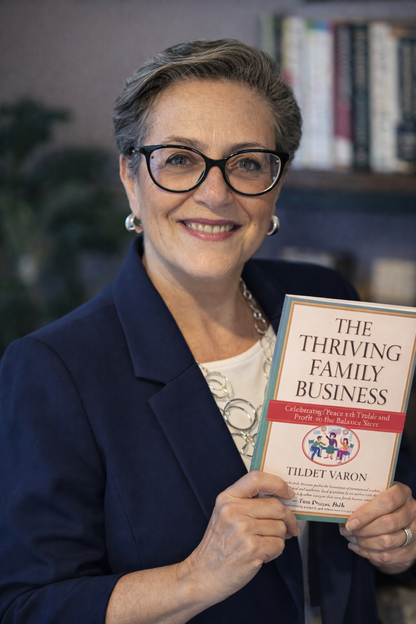
I grew up inside a family business, one of the largest in its industry in Turkey, and I lived through its collapse. That loss is the reason I've spent 15+ years doing this work, alongside 40 years of building businesses of my own. My clients tend to stay for years, and the work always starts the same way: one honest conversation.
Not ready to talk yet? Start with the Family Business Health Assessment. A few minutes, and you'll see where your business stands across communication, roles, systems, and connection.
Common questions
How long does an engagement last?
Long enough to change how the business runs, which varies by family. Early shifts often show up within the first few sessions; many client relationships continue for years because the work compounds.
Does the whole family have to participate?
It helps, and it isn't required. The work can start with whoever is ready. When one person begins communicating differently, the room tends to follow.
We're doing well financially. Is this still for us?
Strong numbers and rising tension is the most common profile I see. The outside can look fine for a long time while the inside gets heavier. Sooner is easier.
What if the hardest conversation involves me?
Then you're the right person to be reading this. A neutral room protects you too. Clarity doesn't damage trust. Avoidance does.
WEEKLY INSIGHT
The Peace & Profits Table
A weekly seat at the table for family business leaders building something worth carrying forward
Weekly insights on the conversations, decisions, and dynamics that help family businesses grow - without losing the family in the process.
What 15 years inside family businesses has taught me
The conversations most families avoid - and what becomes possible when they have them
Practical tools for clarity, communication, leadership, and growth
JOIN THE TABLE
One email a week.
Personal, practical, and rooted in real family business experience.
Sent with intention.
Read by people who mean business.
United States







___MESSAGE___
___MESSAGE___